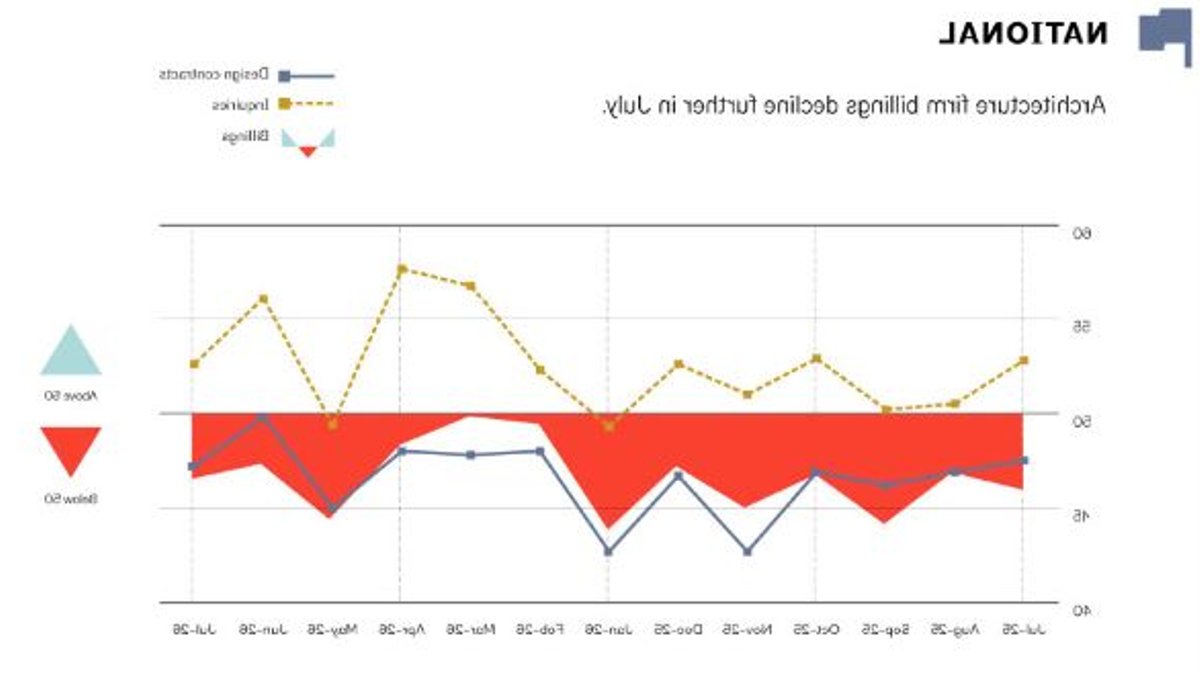
Architecture firm billings fell slightly in July, signaling continued weakness in the design sector. The AIA/Deltek Architecture Billings Index® (ABI) posted a score of 46.6 for the month, down from June’s reading. This decline extends the current slump in business conditions, which has now lasted for nearly three and a half years—the longest period of contraction in the ABI’s history.
Contracts and Inquiries
Clients continued to demonstrate interest in new work, as the volume of inquiries rose again in July, albeit at a slower tempo than the surge seen the month before. At the same time, the monetary value attached to newly signed design contracts slipped further after a near‑break‑even performance in the previous reporting period. The combination of rising curiosity and falling contract commitments shows a cautious market stance, where prospective owners are still scouting opportunities but are reluctant to lock in expenditures.
All four U.S. regions reported soft business conditions throughout the month. The Northeast registered the weakest outlook for the second consecutive month, reinforcing a pattern of persistent restraint in that area. In contrast, the South, West, and Midwest each exhibited a modest easing of the downward trajectory, suggesting that localized factors may be tempering the overall decline without reversing it.
Billings contracted across every specialization. Firms focused on multifamily residential and institutional projects had previously enjoyed modest gains earlier in the year, but those early gains have now dissipated as the broader environment tightened. Companies whose primary work lies in commercial and industrial design have not recorded a rise in billings since the July of four years ago, indicating a prolonged period of stagnation for that segment.
Regional and Sector Breakdown
The regional averages reveal a gradient of performance, with the South leading the pack, followed closely by the West and the Midwest. The Northeast lagged behind, posting the lowest regional figure. This spread reflects how local economic conditions, development pipelines, and policy environments can shape the health of architecture firms differently across the country.
Related: KBIS 2027 calls for presenters in Las Vegas
Sector‑level scores paint a similar picture of divergence. Multifamily residential practices posted a relatively stronger index, while institutional firms trailed only slightly behind. The commercial/industrial category settled near the middle of the sector spectrum, and firms with mixed practices—those that do not concentrate at least half of their billings in a single category—registered the lowest reading. Because these sector and regional indices are calculated as three‑month moving averages, short‑term fluctuations are smoothed, which can mask sudden spikes or drops that might otherwise appear in a single‑month snapshot.
Macroeconomic uncertainty continues to weigh on the built environment, according to AIA Chief Economist Richard Branch. High oil prices are putting upward pressure on inflation and may lead to even higher rates in the back half of the year. This will put additional pressure on developers and may lead to a further weakening in billings.
The ongoing contraction has broader implications for the industry’s supply chain. Developers facing tighter financing conditions are likely to defer or scale back projects, which in turn reduces the pipeline of work available to architects. When developers hesitate, the ripple effect can be felt in related sectors such as construction, engineering, and material supply, amplifying the overall slowdown.
Founded in 1857, the American Institute of Architects (AIA) consistently works to create more valuable, healthy, secure, and sustainable buildings, neighborhoods, and communities. Through more than 200 international, state and local chapters, AIA advocates for public policies that promote economic vitality and public wellbeing. It provides members with tools and resources to assist them in their careers and business as well as engaging civic and government leaders and the public to find solutions to pressing issues facing our communities, institutions, nation, and world. Members adhere to a code of ethics and conduct to ensure the highest professional standards.
Deltek is a leading global provider of enterprise software and information solutions for project‑based businesses and the home of AIA MasterSpec®. More than 30,000 organizations, including 12,000 architecture & engineering firms, rely on Deltek for superior levels of project intelligence, management, and collaboration. Its industry‑focused expertise powers project success for A&E firms of all sizes by helping them achieve performance that maximizes productivity and revenue.


